

Loft boarding doesn’t automatically reduce insulation performance, but boards fitted directly over insulation can compress it. If you’re asking, “does loft boarding affect insulation?”, the key question is whether the flooring presses down on the insulation or obstructs ventilation routes.
It’s a sensible concern, especially if your loft is already boarded or you’re unsure what condition the insulation is in. Storage and insulation can work together when the layout is planned around both. This guide explains how compression, gaps and blocked airflow can affect a loft, what to check before boarding, and how raised flooring creates storage space above insulation. It also covers when an insulation top-up, hatch upgrade or change to the layout may be worth considering.
Key Takeaways
- Does loft boarding affect insulation? It can if boards compress insulation or cover ventilation routes. The effect depends on the setup.
- Look for flattened or uneven insulation, uncovered patches and vents that are blocked by flooring or stored items.
- Before boarding, note the insulation’s condition, available depth, vents, hatch and obstructions. Don’t cut or move insulation just to make boards fit.
- Raised subframes support a storage platform above insulation, leaving room beneath for insulation and, where needed, top-ups.
- A loft assessment helps match the boarding layout to the insulation, structure and access points in your home.
Does loft boarding affect insulation, or is that a myth?
Loft boarding doesn’t automatically reduce insulation performance. The way it’s installed matters. Boards that press down on insulation can reduce its thickness, while flooring or stored items that block vents can interfere with airflow. A raised floor planned around the insulation and ventilation can provide storage without resting on the insulation.
Insulation and boarding have different jobs. Insulation slows heat transfer through the ceiling, helping to keep warmth in the rooms below. Boards provide a surface for storage. The important consideration is what happens to the insulation and airflow beneath and around that surface, not simply whether boards are present.
What does loft insulation do?
Heat naturally moves from warmer areas towards cooler ones. Loft insulation slows that transfer through the ceiling, helping reduce heat loss from the rooms below. This is the basic idea behind thermal insulation principles.
In many homes, quilt insulation is laid between ceiling joists and may continue across them. The material traps air, helping to resist heat flow. The right arrangement depends on the property and loft, so one depth or layout won’t suit every home. Even coverage matters too: thin spots and gaps leave parts of the ceiling less protected.
Why do people worry about boarding over insulation?
The concern is understandable. If insulation rises above the joists, boards fixed directly across them may push it down. Compression reduces the quilt’s thickness, which can make it less effective. When quilt insulation is squashed, it has less depth to help slow heat transfer.
Insulation can also be moved, pulled aside or removed to make room for boards or stored items. If it isn’t put back evenly, gaps can be left behind. Boards or belongings may also cover eaves vents, restricting airflow where the loft relies on those openings. These problems relate to the layout and handling, rather than to boarding itself.
Before choosing a storage surface, consider the insulation’s condition and position, the available space and any ventilation routes. Don’t squeeze quilt insulation into a shallow gap or shift it aside without understanding what it covers. A raised subframe can support flooring above the insulation, leaving space beneath it, but the loft should still be checked for separate insulation or airflow issues.
How compression, coverage, and airflow can affect loft insulation
Insulation can be affected in several ways. Compression reduces its depth, gaps leave parts of the ceiling less protected, and blocked vents may interfere with airflow. These are separate issues, so the presence of boards alone doesn’t show how well the insulation is working.
Insulation performance depends on its condition and installation, not simply on whether boards are present. The Energy Saving Trust’s guidance on loft insulation also highlights the need to install insulation without compressing it and to maintain suitable airflow.
What happens when insulation is compressed?
Compare a loose quilt with one squeezed under a heavy object: the compressed section has less depth. Quilt insulation works partly by trapping air within its material, so pressing it down can reduce how well it slows heat transfer.
Boards resting directly on insulation can keep it compressed for as long as they remain in place. The pressure may also vary across the loft, leaving some sections flattened and others loose. A raised support system holds the flooring above the insulation instead, where the loft layout allows.
Coverage matters as much as depth. Insulation pulled aside to fit flooring, shifted during storage or left short around an obstacle can create thin patches. These areas may allow more heat to pass through the ceiling than the well-covered sections. Look for visible bare strips, sagging quilt and abrupt changes in level, but don’t pull insulation about before understanding where it belongs.
Gaps can be easy to miss around the loft hatch, eaves, pipes and wiring. A small uncovered patch doesn’t mean the whole loft has failed, but several gaps or uneven sections may show that the insulation needs attention. A careful visual inspection can help identify whether the issue is local or more widespread.
Can boarding interfere with loft ventilation?
Insulation slows heat loss through the ceiling. Ventilation helps air move through parts of the loft where vents are provided. They serve different purposes, and one isn’t a substitute for the other.
Stored boxes or poorly planned flooring can cover eaves vents or other ventilation openings, where present. Loft designs differ, so don’t assume every home has the same ventilation routes. Keep visible vents clear and avoid packing items tightly into the eaves. Include airflow routes in the layout before changing the flooring or storage arrangement.
If you’re planning storage, raised loft boarding can provide a platform above insulation rather than resting on it. The arrangement should still take account of the insulation’s condition and the ventilation features in your loft.
Loft insulation and boarding: how common setups compare
The effect of loft boarding depends on how the floor, insulation and available space fit together. Compare the setup with the insulation’s position and condition before deciding what to change. The table is a starting point: the actual loft layout determines what will work.
| Loft setup | Compression risk | Accessible storage | What needs inspecting |
|---|---|---|---|
| Boards fitted directly on joists | Can be high if insulation projects above the joists and is pressed down | Yes, where the boards are sound and the area is reachable | Insulation depth and condition, joist height, gaps, and ventilation routes |
| Raised boarding above insulation | Lower where the support system keeps the floor clear of insulation | Yes, with the usable area shaped by the loft layout | Insulation condition, support positions, access, and vents |
| Existing boards with insulation below | Unclear until the insulation and space beneath the boards are checked | Usually, if the existing floor remains safe to use | Insulation coverage, available depth, signs of disturbance, and airflow |
Boards fitted directly on joists
Boards fixed at joist height may press on quilt insulation laid between and above the joists. The risk depends on how high the insulation sits and how much clearance the joists provide. In some lofts, insulation is level with the joists; in others, it extends above them. Don’t assume one board arrangement suits both.
If insulation is already flattened, patchy or pushed aside, boards may conceal the problem rather than fix it. Check the visible edges and sections, and don’t force boards into place if they won’t sit level.
Raised boarding above existing insulation
A raised subframe creates a gap between the insulation and storage floor. It can provide access to stored items while leaving room for insulation below, rather than using the insulation as a support. It won’t, by itself, repair thin or damaged insulation or resolve a separate ventilation issue.
The supports need to suit the loft’s structure and layout. The hatch, awkward corners and ventilation openings all affect where storage can go. If there are existing boards, the flooring may provide storage already, but it can also hide gaps or uneven insulation. The condition and arrangement of the loft should guide the next step: keep the current floor, adjust the layout or consider raised boarding. To answer “does loft boarding affect insulation?”, inspect the setup rather than judging by the boards alone.
What to check before boarding a loft with insulation
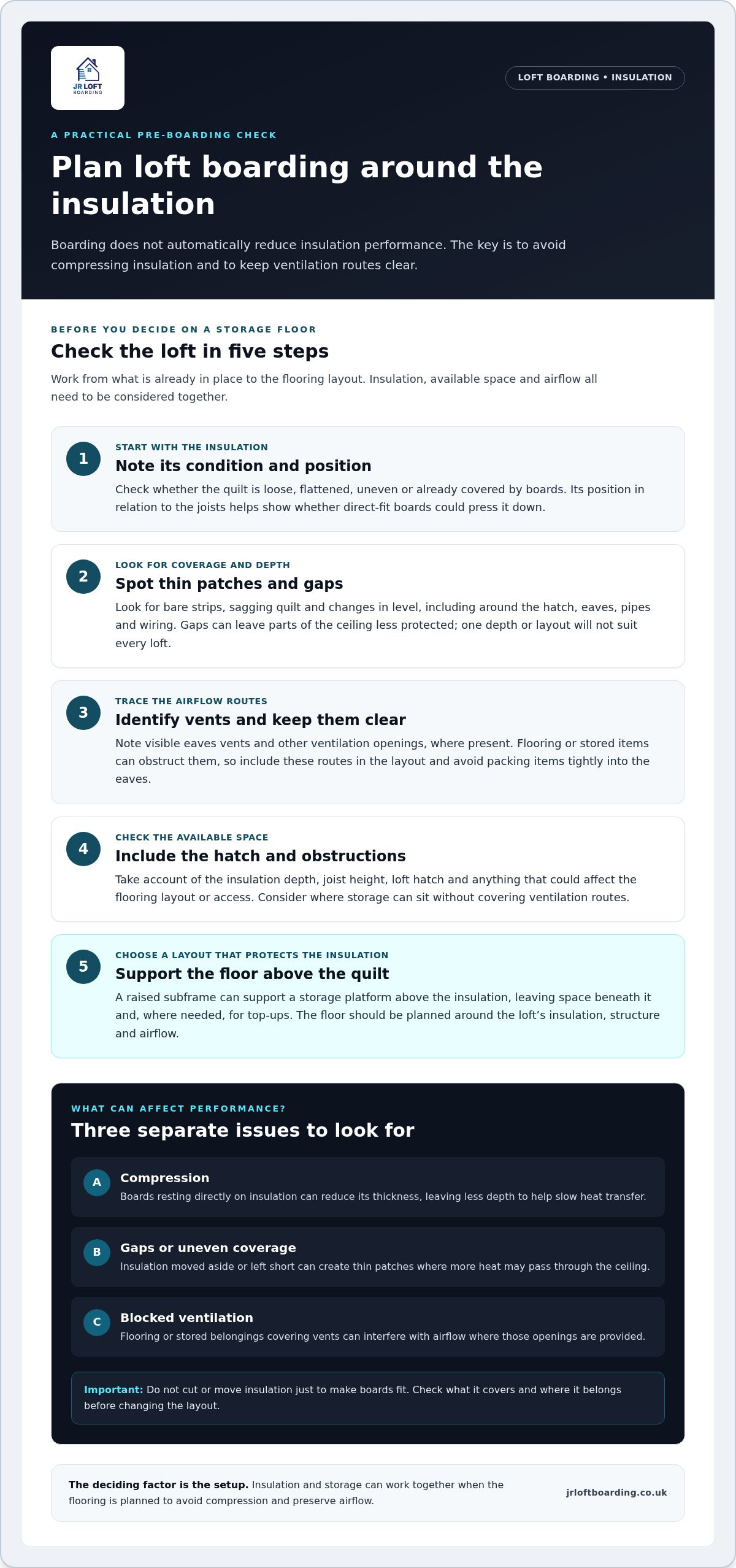
Check the loft before work starts so the storage plan fits the space rather than forcing the insulation to fit the boards. The roof structure, wiring, pipework, hatch position and available access can all affect what’s practical. These checks help identify where the layout needs careful planning.
- Inspect the insulation. Look for areas that appear flattened, displaced, damp or uneven. Note what you see, but don’t assume the cause. Avoid pulling the insulation apart or shifting it aside to clear a route for boards.
- Measure the available depth. Check the space from ceiling level to the intended finished floor, and note any changes across the loft. Clearance can vary near the eaves or around roof timbers. For more background on choosing a suitable depth, see how much loft insulation depth you need.
- Locate vents and airflow routes. Identify eaves or roof vents where present, and plan to keep them clear. Loft designs vary, so don’t assume vents are in the same place or work in the same way in every home.
- Note obstructions and access points. Mark the hatch, roof timbers, cables, pipes and anything else that affects where flooring or supports could go. Keep services visible and reachable, and consider how you’ll carry items into and out of the storage area.
Don’t cut, remove or compress insulation as a quick way to make boards fit. If material seems to need moving, pause and consider the full layout first. Clearing one section could leave a gap elsewhere or make a service harder to reach. Existing boards may also hide the insulation below, so account for that before deciding what can stay.
Include the hatch in your plan. Check whether it’s insulated and draught-proofed, as the hatch is part of the boundary between the home and loft. Its size and position also affect access. JR Loft Boarding installs, enlarges and relocates insulated, draught-proof loft hatches.
Once you’ve noted these details, you’ll have a clearer picture of the space and its constraints. A raised subframe can provide a storage floor above insulation, but the supports, access and ventilation still need to suit the loft. If the insulation needs attention, a top-up or upgrade can be planned alongside the flooring. Plan raised loft boarding around your insulation with JR Loft Boarding.
How JR Loft Boarding helps protect insulation while adding storage
Useful loft storage shouldn’t come at the expense of insulation. JR Loft Boarding supplies and installs raised loft boarding, using subframes to create a floor above the insulation rather than resting boards on it. This provides a practical storage surface while leaving room for insulation beneath.
The right layout depends on the loft. Insulation condition, roof structure, hatch position, ventilation routes and existing obstructions all shape what can be boarded. A raised floor can help avoid compressing insulation, but it won’t fix every insulation or ventilation issue on its own. Those details need to be considered together.
A raised floor planned around the loft
Every loft has its own shape and constraints. A clear central area might suit accessible storage, while low eaves, roof timbers or services may limit where flooring can go. JR Loft Boarding plans the raised layout around the available space, keeping the storage floor above the insulation and access routes usable.
JR Loft Boarding works with homeowners in Glasgow and nearby communities, including Airdrie, Motherwell, Paisley, Hamilton, Bishopbriggs, Newton Mearns, East Kilbride and Cambuslang. If you’re weighing up storage options, the raised loft boarding in Glasgow guide gives a broader look at planning a more usable loft. The answer to “does loft boarding affect insulation?” depends on how the floor will sit in your particular loft, not on an assumption that every home needs the same setup.
When insulation or the loft hatch needs attention
Boarding can be one part of the work. If the existing insulation is thin, uneven or otherwise needs attention, an insulation top-up or upgrade can be planned alongside the storage layout. Planning the flooring and insulation together is more practical than adding boards first and trying to fit the insulation around them afterwards.
The hatch deserves attention too. An insulated, draught-proof hatch addresses the loft opening as part of the home’s thermal boundary. Its position and access also affect how easily you can reach the storage area, so include it in the overall plan.
There’s no need to rush into changing a loft that already has boards. The insulation’s condition and the way the existing floor is arranged can help show whether the layout needs adapting or whether other work should come first. A considered plan makes the space more useful without treating insulation as something to squash or move out of the way.
If you’re in the Glasgow area and would like to discuss a suitable storage layout, talk to JR Loft Boarding about raised loft storage.
Plan a loft that works for your home
If you’re still asking “does loft boarding affect insulation?”, let the loft’s condition guide your decision rather than ruling out storage. Start by considering what you want to store and how often you’ll need to reach it. A useful layout should suit those everyday needs, not simply add floor space.
JR Loft Boarding plans raised loft subframes to create flooring without compressing insulation. Where the loft needs more attention, boarding can be considered alongside insulation top-ups or upgrades, and an insulated, draught-proof hatch can address the loft opening. Planning these elements together helps shape storage around the home’s layout, without assuming the same arrangement suits every property.
For a practical next step, share what you hope to store and any concerns about your insulation. Talk to JR Loft Boarding about a raised loft storage solution. A suitable plan can make your loft more useful while keeping insulation in the conversation from the start.
Frequently Asked Questions
Can loft boarding be installed without removing the insulation?
Often, yes. Raised loft boarding can sit above insulation, so removing it isn’t always necessary to create storage space. Before work starts, note whether the insulation is dry, evenly placed and accessible around pipes and cables. If it needs repair or replacement, plan that first. Doing so can help avoid lifting newly fitted flooring later and disturbing the insulation again.
Does loft boarding make a house colder?
The answer to “does loft boarding affect insulation?” isn’t automatically yes. It depends on the finished layout. If a room feels colder after work, check whether the hatch closes properly and whether insulation remains in place around the loft perimeter. Room temperature can change for other reasons too, so consider the whole loft rather than assuming the boards are responsible.
Can loft boarding cause condensation?
Boarding alone doesn’t mean condensation will occur. If you find droplets, damp patches or mould, don’t cover them with flooring or stored belongings. Check whether the area is near a ventilation opening or another possible source of moisture, but don’t assume the cause from appearance alone. Persistent signs need attention before you add storage, so the underlying issue isn’t hidden beneath the boards.
Can I add more loft insulation after the boards are fitted?
It may be possible, depending on the existing floor and how easily the space beneath it can be reached. For example, boards across the full loft may need to be lifted or the layout adjusted to reach areas that need a top-up. Planning insulation work before completing the floor can make access simpler. An assessment helps establish a sensible order for the work.
Should I cut loft insulation to make room for boards?
No. Don’t cut insulation as a quick fix. Removing a strip to clear a joist or service can leave an uncovered area that’s easy to miss once flooring is down. Mark pipes, cables and roof features before deciding where boards should go. This gives you a clearer picture of the space and helps avoid changing the insulation just to force a particular layout.
Can loft boarding affect a new-build home’s warranty?
JR Loft Boarding’s raised boarding solutions are designed for new-build properties and to maintain builder warranties. The exact conditions depend on your home and its warranty documents, so read those before planning changes. Keep records of the work and any guidance supplied with your property. This gives you useful information to refer to if you review the loft arrangement later.


