
The safest loft ladder for heavy items may not be the one that feels strongest. A ladder is for getting you into the loft, not for carrying bulky loads as you climb. The hatch, ladder position and way you move each item matter just as much.
It’s understandable to want a stable, manageable ladder when storage boxes or awkward belongings need to go upstairs. But a wider or sturdier-looking design doesn’t automatically make carrying a heavy item safer. Keep yourself free to climb carefully, and plan to pass bulky items up separately rather than carrying them on the ladder.
This guide compares folding, sliding and concertina loft ladder designs, and explains which features can help with steady access. You’ll also learn why hatch dimensions and ceiling height affect your options, and how to think about a safer way to move stored items. A well-fitted ladder, suitable hatch and sensible handling plan work together. JR Loft Boarding supplies and fits Easystow aluminium loft ladders, with handrails and safety features tailored to your ceiling height and existing hatch opening.
Key Takeaways
- The safest loft ladder for heavy items is only part of a safe setup; the hatch, installation and handling plan all matter.
- Compare folding, sliding, telescopic and fixed-style access by how each suits your available space and layout, not by a “heavy-duty” label alone.
- Measure ceiling height, hatch opening and floor space, then consider the route to the items you store in the loft.
- Before moving bulky belongings, clear the route and assess the load. Use a separate lifting method where needed, and make several manageable trips.
- JR Loft Boarding fits Easystow aluminium loft ladders with handrails and safety features tailored to your ceiling height and hatch opening in Glasgow and nearby towns.
Safest loft ladder for heavy items: what makes access safer?
A safer loft setup is more than a ladder with a reassuring label. The ladder needs to suit the ceiling height and hatch, be fitted securely, and open into a clear area. You also need a plan for the items themselves. A box that blocks your view or stops you gripping the ladder can turn an ordinary climb into a difficult one.
The safest loft ladder for heavy items is not a way to carry heavy items up or down. Keep the ladder for personal access and move bulky loads separately. Climbing with a box can affect your balance, hide the next step and leave you with less grip. If you can’t keep a clear view and steady hold, don’t carry the item on the ladder.
Loft ladders come in different forms and materials, with features such as handholds and footpads depending on the design. The Attic ladder (loft ladder) overview gives a general introduction to common types and features. Those details can help you understand a design, but they don’t tell you whether it suits your home or makes carrying a load safe.
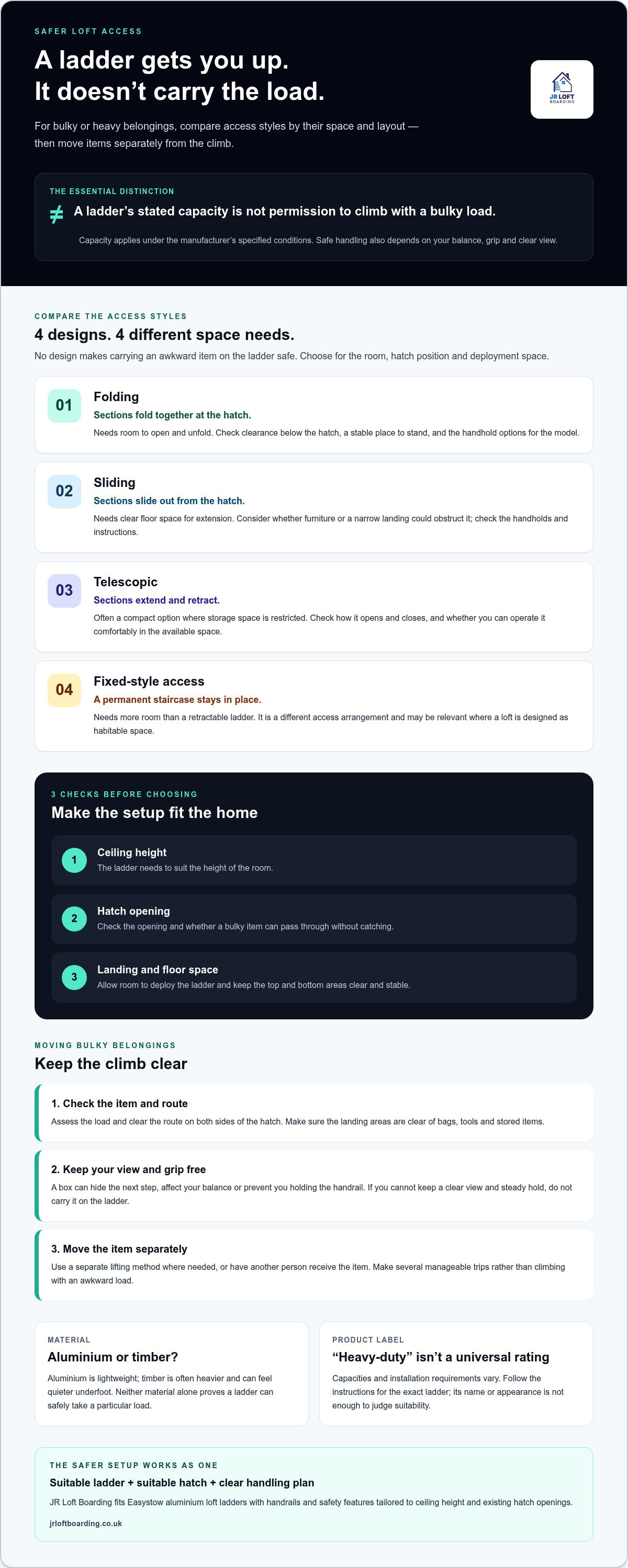
A ladder’s capacity is not permission to climb with a bulky load. A stated limit and safe handling practice answer different questions: the first concerns the ladder under specified conditions, whilst the second concerns your balance, grip and clear view.
Does a heavy-duty loft ladder make carrying heavy items safe?
No. “Heavy-duty” is not enough to establish suitability for a particular person, hatch or task. If a ladder has a stated capacity, that applies only under the manufacturer’s conditions. Read the instructions for the exact ladder rather than guessing from its name or appearance. Also distinguish the user’s permitted weight from whether an additional item can be carried safely. A limit does not make an awkward load manageable.
Don’t assume that a ladder designed for a higher load lets you carry more. The item may shift, catch against the hatch or prevent you holding the handrail. If it’s heavy, wide or awkward to grip, arrange a separate way to move it instead.
Why the hatch and landing area matter too
A small hatch can leave little room to turn, tilt or guide a bulky box through without catching its edges. Before moving anything, check the route on both sides of the opening. The top and bottom landing areas should be clear, stable places to stand, with enough room to handle the item once it’s off the ladder. Don’t leave bags, tools or stored items underfoot.
If the opening or its position makes access awkward, hatch enlargement or relocation may be part of a planned solution. JR Loft Boarding installs enlarged or relocated loft hatches and professionally fits Easystow aluminium ladders, with handrails and safety features tailored to ceiling height and existing hatch openings. The ladder, opening and storage route should work as one practical arrangement.
Which loft ladder styles are worth comparing for bulky loads?
Start with the shape of the room, the hatch position and how often you use the loft. A ladder that folds neatly into a compact landing may suit one home, whilst another needs a design that can extend without obstructing furniture. No style makes carrying a bulky item on the ladder safe. Compare how each design fits your access needs, then plan to move awkward belongings separately.
| Style | Space and deployment | What to consider |
|---|---|---|
| Folding | Sections fold together and are usually stored at the hatch. They need room to open and unfold. | Check there’s clearance below the hatch and a stable place to stand as you operate it. Handhold options vary by model. |
| Sliding | Sections slide out from the hatch. The landing area needs enough clear floor space for the ladder to extend. | Consider whether furniture or a narrow landing could obstruct deployment. Check the design’s handholds and instructions. |
| Telescopic | Sections extend and retract, often making this a compact option for restricted storage space. | Check how it opens and closes, and whether you can operate it comfortably in the available space. Features differ between models. |
| Fixed-style access | A permanent staircase stays in place and needs more room than a retractable ladder. | This is a different access arrangement, not a compact loft ladder. It may be relevant where a loft is designed as habitable space. |
Folding, sliding and telescopic ladders compared
Each style has a different opening path. A folding ladder needs space for its sections to swing out; a sliding ladder needs room to extend; a telescopic model needs access to operate its sections. Walk through the deployment area before choosing. If a box cannot pass through the hatch without being turned or tilted, the ladder style won’t solve that problem. Arrange a separate lifting method or another person to receive the item, rather than carrying it whilst climbing.
Aluminium, timber and heavy-duty labels
Aluminium is lightweight, whilst timber is often heavier and can feel quieter underfoot. These material differences may affect handling and day-to-day use, but neither material proves that a ladder can safely take a particular load. “Heavy-duty” is not a universal rating. Product capacities and installation requirements vary, so follow the exact manufacturer’s instructions. The OSHA standards for ladder safety and load capacity cover US construction work, so they aren’t a substitute for UK product instructions.
The safest loft ladder for heavy items is the one suited to your hatch, ceiling height and available floor space, paired with a sensible plan for the load. JR Loft Boarding supplies and fits Easystow aluminium loft ladders with handrails and safety features tailored to the home. If you’re considering a fitted ladder in Glasgow or nearby, discuss your loft access setup with JR Loft Boarding.
How to judge a loft ladder against your home and storage needs
A ladder can look suitable in a catalogue and still be wrong for your loft. Start with the space you have, then think about who will use the access and what needs to go through the hatch. The measurements and everyday route matter more than a broad label such as “compact” or “heavy-duty”.
Measure ceiling height, hatch opening and clearance
Measure from the finished floor below to the ceiling at the hatch, then record the clear width and length of the opening, not just the outer frame. Note nearby doors, furniture, light fittings and anything that could obstruct the ladder as it opens. Check the space needed to stand at the bottom and step off at the top. Write these details down before comparing options.
Use this checklist to build a clear picture of the access area:
- Ceiling height: measure floor to ceiling where the ladder will meet the floor.
- Hatch opening: record the clear internal dimensions and note its position.
- Floor space: identify the area needed to open and use the ladder, including any door swing.
- Route into the loft: consider turns, low beams and the space available to move belongings beyond the hatch.
The hatch and ladder need to suit one another. A ladder is not a universal fit, and the right dimensions depend on its design and installation requirements. Compare your notes with the exact manufacturer instructions. The final setup should be properly fitted and suited to the ceiling height and opening, rather than adjusted to force a mismatch.
Match the access setup to the items you store
Think about how often you use the loft and who needs to get up there. Frequent access to small, manageable boxes calls for a clear route and a ladder that the intended user can operate as instructed. Occasional bulky items need a separate handling plan. Don’t assume an awkward item can be carried on the ladder just because it fits through the hatch.
Plan where belongings will sit before filling the loft. Keep regularly used items near the hatch, and avoid placing heavy belongings where reaching them means repeated trips across stored goods. Raised loft boarding can create a more organised storage area above the insulation, but the layout should still leave a clear route to the hatch. Consider the full path from the room below to the item’s final position, not just whether it passes through the opening.
If you’re lifting an item separately, make sure its route is clear and choose a manageable method for its size and shape. The OSHA guidelines for safe lifting and carrying offer general handling advice, but they are US guidance, not UK regulations. For your loft, the key is to avoid a load that blocks your view or grip and to use the ladder only as directed.
With measurements, users and storage habits in view, you can compare ladder options against the actual home. That’s a more useful way to find the safest loft ladder for heavy items than choosing by style name alone.
How to move heavy loft items without carrying them on the ladder
Keep the ladder for access, not for carrying a bulky load. A box can hide a step, catch against the hatch or stop you gripping the ladder properly. Before moving anything, work through a simple plan. If the item is awkward to control, don’t try to manage it whilst climbing.
- Clear the route. Move belongings, tools and loose items away from the bottom landing, hatch and intended storage spot. Check that doors can open fully and that nobody will need to step around obstacles.
- Assess the item. Consider its weight, size, shape and whether it can be broken down. Check that it can pass through the hatch without forcing it or blocking your view.
- Choose a separate lifting method. Split the load, arrange suitable help or plan a mechanical lift using equipment that is appropriate for the item and the setup.
Prepare the loft and split the load where possible
Make sure the landing areas at both ends are clear before starting. Keep the ladder steps free of bags and tools, and don’t leave loose items where someone could trip. If a container holds several smaller belongings, divide them into manageable loads when you can do so safely. Take multiple trips rather than trying to carry everything at once.
Keep your hands available for steady movement on the ladder. A small box may still be difficult to manage if it slips, needs two hands or blocks your view. Put each load down in a clear place before returning for another. Take your time, and don’t use the ladder as a temporary shelf for items waiting to be moved.
When to pause and choose another method
Stop if the item feels too heavy, is hard to grip or blocks your view. Don’t lean, twist or pass a load between people whilst someone is climbing. Get suitable help or use a properly planned lifting method instead. A second person does not make it safe to carry a bulky item on the ladder.
A hoist or other mechanical aid needs to be suitable for the load and set up for the space. Don’t improvise with a rope or attach lifting equipment to an uncertain fixing. Plan where the item will travel, where it will be received and how it will be kept clear of people. If you can’t establish a controlled route, pause and rethink the move.
The safest loft ladder for heavy items still isn’t a substitute for a safe handling plan. A fitted ladder, clear hatch area and suitable way to move stored belongings each have a part to play. If you’re planning loft access in Glasgow or nearby, discuss a fitted loft ladder and hatch setup with JR Loft Boarding.
Choosing a fitted loft ladder in Glasgow for safer storage access
A useful loft access setup starts with your home, not a product label. The hatch position, ceiling height and space around the opening all affect how a ladder can be fitted and used. Your storage plans matter too. Access for occasional boxes may call for a different layout from a loft used regularly to retrieve stored belongings.
What a tailored ladder fitting considers
JR Loft Boarding supplies and professionally fits Easystow aluminium loft ladders. The ladder setup is tailored to the ceiling height and existing hatch opening, with handrails and safety features chosen to suit those conditions. These details help shape a practical installation, but they don’t remove the need to use the ladder as instructed or make carrying bulky items whilst climbing safe.
A fitted ladder should work with the opening, rather than being treated as a universal match for every hatch. If the existing opening or its position makes access awkward, JR Loft Boarding can install an enlarged or relocated loft hatch as part of a planned access solution. That can help make the opening and ladder work together for the home and its intended storage use.
Plan the full route into your loft
Look beyond the ladder itself. Consider the space where it opens, the landing area at the top, and the route to where belongings will be stored. A clear hatch can still lead to an awkward journey if stored items block the way or there’s nowhere to put a box once it’s through. Keep frequently used belongings within easy reach, and plan a separate method for moving bulky items.
Before fitting, useful details to have in mind include:
- The ceiling height and clear dimensions of the existing hatch.
- Doors, furniture or other obstructions around the ladder’s opening area.
- How often the loft will be used and who needs to access it.
- The kind of storage planned, including whether raised loft boarding would help organise the space.
This information gives the ladder choice a practical context. The safest loft ladder for heavy items is part of a well-matched setup, not a way to carry heavy loads on the climb. JR Loft Boarding also fits raised loft boarding to help make storage more usable, alongside ladder and hatch work.
If you’re in Glasgow or a nearby town, you’re welcome to discuss a fitted access setup that suits your hatch, ceiling height and storage plans. A calm look at the whole route can help you decide whether the existing opening works or whether a different hatch position would make access more practical.
Make your next step a practical one
Before settling on the safest loft ladder for heavy items, take a fresh look at how you use the loft. Note what you store, who needs access and where a clear landing space could be kept. This gives you a useful starting point for planning access that works for everyday storage, not just for the ladder itself.
JR Loft Boarding supplies and professionally fits Easystow aluminium loft ladders, with handrails and safety features tailored to ceiling height and existing hatch openings. The team serves Glasgow and nearby towns, helping homeowners plan a fitted access setup around their loft and storage needs.
A little planning now can make loft storage easier to organise and help you avoid asking a ladder to do more than it should. Talk to us about a safer loft access setup, and take the next step towards making better use of your loft.
Frequently Asked Questions
Is it safe to carry heavy items up a loft ladder?
No. Carrying a heavy item whilst climbing can affect your view, footing and grip, so move it separately. At floor level, see whether the item can be divided, repacked or taken out of a rigid container. If you can’t control it comfortably on level ground, don’t try to carry it on the ladder. Keep the ladder clear for climbing and arrange a separate lift or suitable help.
What type of loft ladder is safest for heavy boxes?
No single ladder style is safest for every home or user. Choose one that suits the hatch and ceiling height, can be operated as instructed and is manageable for the person using it. The safest loft ladder for heavy items still doesn’t make carrying a heavy box on the climb safe. Plan how to move bulky belongings separately, even if the ladder itself feels steady.
Can I use a loft ladder if the hatch is small?
Possibly, if a ladder is designed for the clear opening and can be installed as instructed. But a narrow hatch may stop a large box or furniture part from passing through, even if the ladder fits. Measure the opening inside the frame, not the outer trim. If the access dimensions are restrictive, JR Loft Boarding can install an enlarged or relocated loft hatch.
How do I check the weight limit of a loft ladder?
Identify the ladder’s exact model and read its manufacturer instructions or product label for the stated maximum load and conditions. Check whether the limit includes the user and anything carried, rather than assuming what the figure means. Don’t estimate from the ladder’s material or a “heavy-duty” label. If you can’t identify the model or find its instructions, don’t rely on a guessed capacity.
Are aluminium loft ladders suitable for household storage?
Yes, an aluminium loft ladder can provide household storage access when it suits the hatch and is installed and used as instructed. The material alone doesn’t establish the ladder’s capacity, and it isn’t a way to carry boxes up the climb. Consider how often you’ll use the loft and whether you can operate the ladder comfortably each time, including when retrieving seasonal belongings.
Should I get help to move a bulky item into the loft?
Yes, if the item is awkward to grip, too large to pass through neatly or difficult to control alone. Agree who will handle it and where it will go before lifting. Don’t climb whilst someone passes an item to you, or lean from the ladder to take it. Any hoist or mechanical aid needs to suit the load and have a planned route and secure setup.
Can a loft ladder be fitted to an existing hatch?
Yes. JR Loft Boarding supplies and fits Easystow aluminium loft ladders to existing hatch openings, with handrails and safety features tailored to the ceiling height and opening. If the hatch size or position makes access impractical, JR Loft Boarding can enlarge or relocate it. The fitting service covers Glasgow, Paisley, Hamilton, Airdrie, Motherwell and nearby towns.


