
What if the ladder isn’t the first thing to replace? If “replace old wooden loft ladder” is on your to-do list, start by looking at the hatch and the surrounding structure. A worn or awkward ladder can be a sign that the opening, fixings or frame also need attention.
It’s understandable to want a quick swap when the old ladder feels unreliable. But choosing a replacement before checking the hatch can lead to a poor fit or more work than expected. This guide explains what to look for, how to plan the main stages and when DIY work may be unsafe.
You’ll learn how to assess the ladder, hatch and access space, and when professional fitting is a sensible choice. For homeowners in Glasgow and nearby areas, JR Loft Boarding supplies and professionally fits Easystow aluminium loft ladders, with handrails and safety features suited to different ceiling heights and existing hatch openings.
Key Takeaways
- Look for visible wear, awkward movement and signs that access feels unreliable. Age alone doesn’t mean a ladder is unsafe.
- Before you replace old wooden loft ladder access, consider the hatch opening, ceiling height and clearance around it.
- Compare keeping the ladder, replacing it alone or addressing a wider hatch issue by considering its condition, operation and fit.
- Plan the work before starting. Removing or fitting a ladder can involve overhead work and unsafe access, so recognise when it’s beyond a safe DIY job.
- JR Loft Boarding supplies and professionally fits Easystow aluminium loft ladders in Glasgow and nearby areas, with fitting suited to the ceiling height and hatch opening.
When should you replace an old wooden loft ladder?
An old wooden loft ladder can still be usable, but age, awkward movement or visible wear are good reasons to take a closer look. If it’s becoming harder to open, close or secure, don’t dismiss that change as a minor inconvenience. A ladder should feel steady in use and sit properly in its intended position.
Start with what you can see from a safe position. Look for split or soft-looking timber, loose joints, damaged steps, bent parts or fixings that appear to have shifted. These signs don’t prove that the whole ladder needs replacing, but they do mean it needs attention. Don’t climb a ladder that looks damaged or unstable to test it.
What signs suggest a wooden loft ladder needs attention?
Pay attention to changes in how the ladder moves. Difficulty opening, closing or securing it may point to wear or a problem with its hinges or other moving parts. Notice whether it sits unevenly or shifts as it’s operated, but don’t force a stiff mechanism or test it if you’re unsure it’s safe. This overview of types of loft ladders can help you recognise how designs and materials differ.
Consider how you use the loft, too. If carrying items up the ladder feels awkward, or access no longer suits your household, the issue may be the ladder’s design rather than damage alone. A closer assessment can help distinguish between a repairable fault, a ladder that no longer suits the job and a wider access problem. Don’t decide to replace it based on age alone.
Is the ladder the only part that may need replacing?
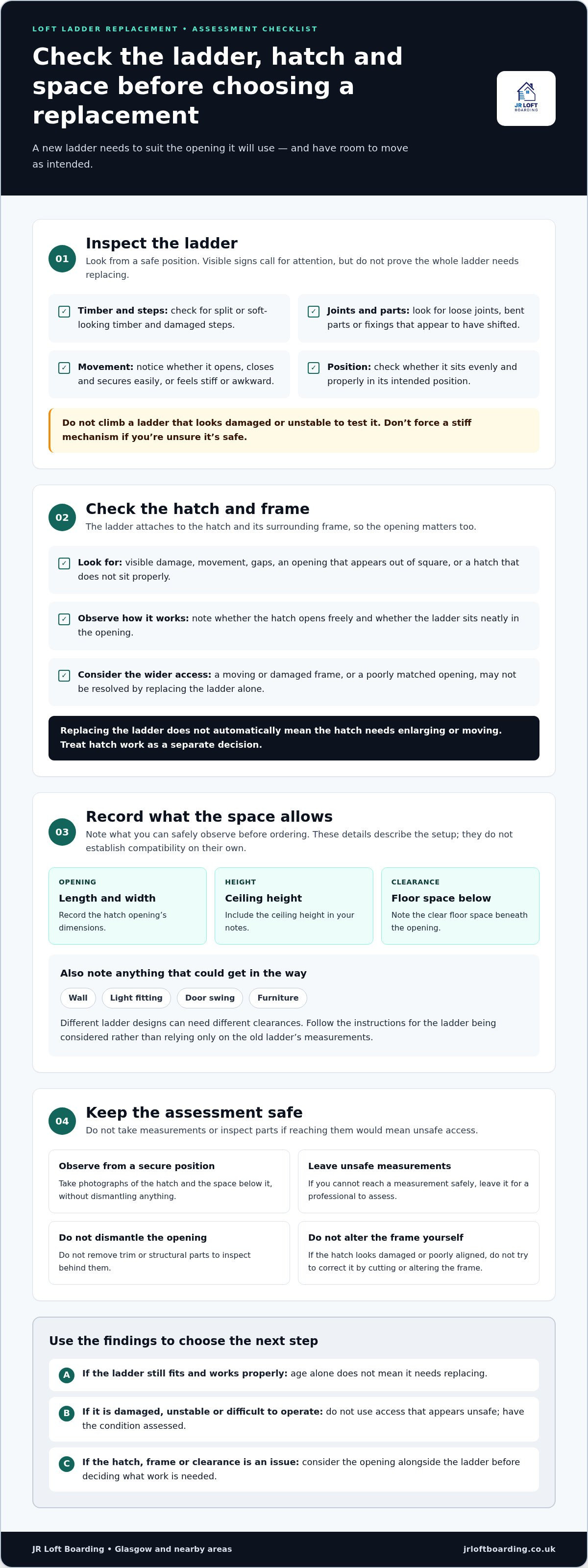
Not always. The ladder attaches to a hatch and its surrounding frame, so look for visible damage, movement, gaps or signs that the ladder doesn’t sit neatly in the opening. Notice whether the hatch opens freely and whether there’s clear space for the ladder to unfold or slide. Observe from a safe position, and don’t remove trim or structural parts to inspect behind them.
If the hatch frame moves, the opening is damaged or the ladder seems poorly matched to the space, replacing the ladder alone may not resolve the access problem. The work depends on the ladder’s condition, the hatch opening and the available clearance. Keep these questions separate: is the ladder sound, and is the opening suitable for the replacement being considered?
A closer assessment makes sense when the ladder is damaged, unstable, difficult to operate or doesn’t sit securely, or when the hatch or frame shows signs of movement or damage. Don’t use access that appears unsafe. Looking at both the ladder and its surroundings helps identify what needs attention before planning a replacement.
Check the loft hatch and opening before choosing a replacement
A replacement ladder needs to suit the opening it will use, not just look similar to the old one. The hatch size, ceiling height and space around the opening all affect whether a ladder can fit and move as intended. A ladder that looks suitable in a photograph or product description may not work with the layout in your home.
Before ordering anything, record what you can safely observe from floor level or another secure position. Don’t climb onto an unstable ladder, lean into the opening or remove trim and structural parts to take measurements. If you can’t reach a measurement safely, leave it for a professional to assess.
What should you measure and observe?
Make a simple note of the hatch opening’s length and width, the ceiling height and the clear floor space beneath it. Record nearby obstructions too, such as a wall, light fitting, door swing or furniture that could affect how a ladder opens or is used. These details describe the existing setup, but don’t establish compatibility on their own.
Follow the measurement instructions for the ladder you’re considering. Different designs can need different clearances, so don’t rely only on the old ladder’s measurements. Take photographs from safe positions, including one showing the hatch and the space below it. This helps describe the layout without dismantling anything. Use the ladder maker’s fitting and safety instructions when comparing options, and don’t take measurements that require unsafe access.
When might the loft hatch need attention too?
Look for visible damage, an opening that appears out of square, gaps around the hatch or a hatch that doesn’t sit properly. These signs may mean the opening needs attention, but don’t try to correct alignment by cutting or altering the frame yourself. A ladder that doesn’t fit may call for a different model, or a separate decision about the hatch.
Enlarging or moving a hatch isn’t automatically necessary just because the old ladder is being replaced. It’s a separate access decision based on the opening, the chosen ladder and the surrounding space. If the hatch is damaged or poorly aligned, consider its condition alongside insulation and draught control. Our guide to insulated loft hatches explains what to look at.
Check hatch compatibility before ordering a ladder, because the opening and available clearance help determine what can fit and operate as intended. In Glasgow and nearby areas, JR Loft Boarding supplies and fits Easystow aluminium loft ladders suited to different ceiling heights and existing hatch openings. The company also installs, enlarges or relocates loft hatches where access needs attention. Find out more about professionally fitted loft ladders.
Repair, replace or upgrade: which route suits an old wooden loft ladder?
There isn’t one answer for every home. The right choice depends on the ladder’s condition, how reliably it operates, whether it suits the hatch and how you use the loft. A ladder that still fits and works properly may not need replacing just because it’s old. If you plan to replace old wooden loft ladder access, first work out whether the problem is limited to the ladder or involves the opening as well.
Consider three routes: keep the existing ladder if it remains suitable, explore repair for a limited fault, or replace the ladder or address a wider hatch issue if the setup no longer works. Avoid deciding on appearance alone. A new-looking ladder won’t solve an opening that’s poorly suited to it.
When could repair be worth considering?
Repair may be worth exploring if the ladder is generally suitable and the fault appears limited. A problem with how one part moves, for example, may have a different cause from widespread timber deterioration or a ladder that no longer fits the opening. An assessment can help distinguish a minor issue from broader wear.
Don’t try to repair damaged or unstable parts yourself, or use the ladder to test whether a repair has worked. If it shifts, won’t secure properly or has visibly deteriorated, leave it unused until the concern has been assessed. Repair makes sense only if the ladder can be made suitable for its intended use.
When does a full ladder replacement make more sense?
Replacement may be more practical when damage is persistent, operation remains unreliable or the ladder is a poor match for the hatch and available space. The aim isn’t simply to fit a newer version. It’s to choose an arrangement that suits the opening and the way the loft is accessed.
An aluminium ladder offers an alternative to timber, but it still needs to match the hatch, ceiling height and clearance. JR Loft Boarding supplies and professionally fits Easystow aluminium loft ladders, with handrails and safety features suited to different ceiling heights and existing hatch openings. For more on the options, see this guide to loft ladder installation in Glasgow.
A wider access upgrade may be worth considering if the hatch itself is damaged, poorly aligned or unsuitable for the replacement ladder. That doesn’t mean every ladder change needs a new hatch. It means considering the ladder and opening together before deciding on the work.
Keep the ladder if it remains safe and suitable; consider repair for a limited fault; choose replacement or wider hatch work when condition, operation or fit calls for it. This comparison helps you focus on what needs attention instead of assuming one route suits every home.
How to plan a wooden loft ladder replacement safely
Good planning starts before anyone touches a fixing. Removing and fitting a loft ladder can involve overhead work, awkward lifting and access near an opening. A rushed swap can leave you with a ladder that doesn’t suit the hatch or a work area that isn’t safe to use.
Assess the opening before removing the ladder. If the ladder, hatch or surrounding frame looks damaged or unstable, stop. Don’t climb it, force it or use it for support while preparing the job. Arrange a suitable assessment before deciding what work should happen next.
What to do before the old ladder is removed
Use this order to prepare without starting a risky removal:
- Record the setup. From a stable position, note the hatch opening, ceiling height and visible clearance around the ladder. Take photographs if you can do so safely. Don’t reach into the opening or climb on the ladder to get a better view.
- Check the work area. Clear the landing space below the hatch so it isn’t blocked by furniture or stored items. Keep children and pets away whilst work is planned and carried out.
- Choose who will do the fitting. Consider whether the work involves overhead lifting, uncertain fixings, a damaged frame or access that feels unsafe. If so, professional fitting is a sensible alternative to attempting removal yourself.
Don’t stand on chairs, tables or other unsuitable furniture to reach the hatch. Don’t rely on the old ladder for support if you’re unsure of its condition. If measurements can’t be taken safely from the floor, leave that part of the assessment to someone equipped to do it.
What happens during a professionally fitted replacement?
Professional fitting starts by considering the opening, ceiling height and space available for the replacement ladder. This establishes whether the chosen ladder suits the existing arrangement or whether the hatch needs separate attention. Considering the access as a whole helps avoid treating the ladder as the only part of the job.
Removal and fitting are installation work, not steps to copy without the right equipment or experience. The existing ladder is removed and the replacement is fitted to suit the opening. The work depends on the setup. JR Loft Boarding supplies and professionally fits Easystow aluminium loft ladders, with handrails and safety features suited to different ceiling heights and existing hatch openings.
For homeowners in Glasgow and nearby, this guide to loft ladder fitting in Glasgow and nearby explains what to expect from local fitting. If your timber ladder is worn or awkward, arrange professional loft ladder fitting rather than attempting an uncertain removal.
Getting an old wooden loft ladder replaced in Glasgow and nearby
If your wooden loft ladder feels worn, awkward or no longer suits the way you use the loft, a professionally fitted replacement can be a practical next step. JR Loft Boarding supplies and fits Easystow aluminium loft ladders. Fitting is suited to the ceiling height and existing hatch opening, and can include handrails and safety features.
Choosing a replacement involves more than swapping one ladder for another. The hatch, surrounding space and ceiling height all help determine a suitable setup. Professional fitting takes these details into account so the replacement can be considered in relation to the access you already have.
What to have ready when discussing a replacement
A few details can make an initial conversation clearer. Note the type of ladder you have, what concerns you about its condition and how it operates. If it’s safe to do so, take photographs of the hatch and the area below it from stable positions. You can also record the opening measurements and ceiling height if they’re accessible without climbing or leaning into the loft.
Don’t put yourself at risk to gather information. If a measurement is out of reach, leave it for a professional assessment. These notes describe the existing arrangement and help focus the discussion on how the loft is accessed, rather than assuming a particular replacement will fit.
A local route to a better loft access setup
JR Loft Boarding serves Glasgow and nearby areas, including Paisley, Hamilton, East Kilbride, Airdrie, Motherwell, Bishopbriggs, Newton Mearns and Cambuslang. For homeowners in these communities, professionally fitted Easystow aluminium loft ladders offer an alternative to an old timber ladder. Handrails and safety features can be suited to the ceiling height and existing hatch opening.
Replacing an uncertain or awkward ladder starts with a setup planned around the home’s access. Each arrangement differs, so sharing what you can safely observe helps focus the discussion on the ladder and fitting.
If you’re considering how to replace old wooden loft ladder access, get in touch with JR Loft Boarding to discuss a suitable replacement for your home. There’s no need to climb an unreliable ladder to prepare; a clear description and safe photographs are a helpful place to start.
Make your next step a considered one
If you’re ready to replace old wooden loft ladder access, make the next step a conversation about the setup, not a rushed removal. Note what you’d like to improve and how you use the loft. That gives you a clearer starting point for discussing a ladder that suits your home. If the current access seems unsafe, leave it unused until it has been assessed.
JR Loft Boarding supplies and professionally fits Easystow aluminium loft ladders. Handrails and safety features can be suited to different ceiling heights and existing hatch openings. The service covers Glasgow and nearby communities, including Paisley, Hamilton and East Kilbride.
Move towards loft access that better suits your household. Talk to JR Loft Boarding about replacing your old loft ladder and take the next step with a clear picture of what your home needs.
Frequently Asked Questions
Can I replace an old wooden loft ladder without changing the hatch?
It may be possible if the opening and surrounding structure suit the replacement, but a direct swap can’t be assumed. The hatch measurements, ceiling height and fitting requirements of the chosen ladder all matter. For example, a replacement with a different opening or movement pattern may need more clearance than the old one. Assess the hatch before choosing a ladder so you understand whether the work is limited to the ladder or needs wider access changes.
How long does it take to replace a loft ladder?
There isn’t one reliable duration for every replacement. The time depends on the existing ladder, the condition of the hatch, access to the work area and what fitting involves. A straightforward replacement may differ from a job that needs an opening changed or other access adjustments. The nature of the work depends on the setup, so avoid relying on a general estimate if the hatch or surrounding area needs attention.
Is an old wooden loft ladder safe to keep using?
Age alone doesn’t tell you whether a ladder is safe or unsafe. A loose part, visible damage, awkward operation or a feeling of instability are reasons to stop using it and arrange an assessment. Don’t climb it to see whether it holds your weight or try to make a fault appear by operating it repeatedly. Timber ladders don’t all need replacing, but concerns about condition deserve attention before the next use.
Can I remove a loft ladder myself?
Removal can involve overhead work, awkward handling and working close to an opening, so it may not be a suitable DIY job. Don’t start if you’re unsure about the ladder’s stability, how it is supported or the condition of the surrounding frame. Avoid trying to work out the fixings while standing on the ladder. Professional fitting is a practical option, with the work planned around the existing setup.
What should I do with an old wooden loft ladder after replacement?
Disposal options depend on your council’s current arrangements and the ladder’s condition. Check the household waste guidance for the council responsible for your address before taking it anywhere, as collection and drop-off arrangements can vary. If the ladder is in usable condition, look into an appropriate reuse route; otherwise, check whether a suitable recycling option is available. Don’t leave it where it could obstruct a shared area or create a trip hazard.
Can a new loft ladder be fitted if the hatch is small?
A small hatch doesn’t automatically rule out a replacement, but the actual opening, ceiling height and ladder’s fitting requirements determine what may suit. Avoid relying on a universal minimum measurement, as designs differ. JR Loft Boarding assesses ladder fit and carries out hatch work where access needs attention, including hatch enlargement or relocation. Homeowners in Glasgow and nearby areas can consider the ladder and opening as one practical setup.


